Research
How does a person learn to see and understand themselves?
The central promise of psychotherapy is that a person can learn to understand themselves in a new way. But how does this happen? Why can some things be examined clearly while others remain in a blind spot? And what does the therapist actually do in those decisive moments when something shifts?
My doctoral research at the University of Helsinki investigates the development of a new kind of agency in psychotherapy and psychoanalysis. How does a person who has been stuck in relation to a difficult experience begin to find new room to move? This change is born in a relationship that enables one to see more and to grasp possibilities that were not available before.
The development of self-observation and agency is the shared goal of all forms of psychotherapy, though the means vary. Research shows that all psychotherapies work — yet the differences between therapists are large. My research focuses precisely on those micro-moments of change where new possibilities are negotiated: where a person reaches for something new, what becomes an obstacle to it — and how the very obstacle can become a vehicle for change. In particular, I study how the relationship to difficult experiences such as shame, sexuality, and vulnerability can transform: how a person moves from helplessness toward a more active relationship with their own vulnerability. And it is precisely this new kind of agency that makes the end of therapy not an ending but a beginning — the person gains access to their own vitality, relationships, and what matters most to them in a fundamentally new way.
Dialogical Sequence Analysis (DSA)
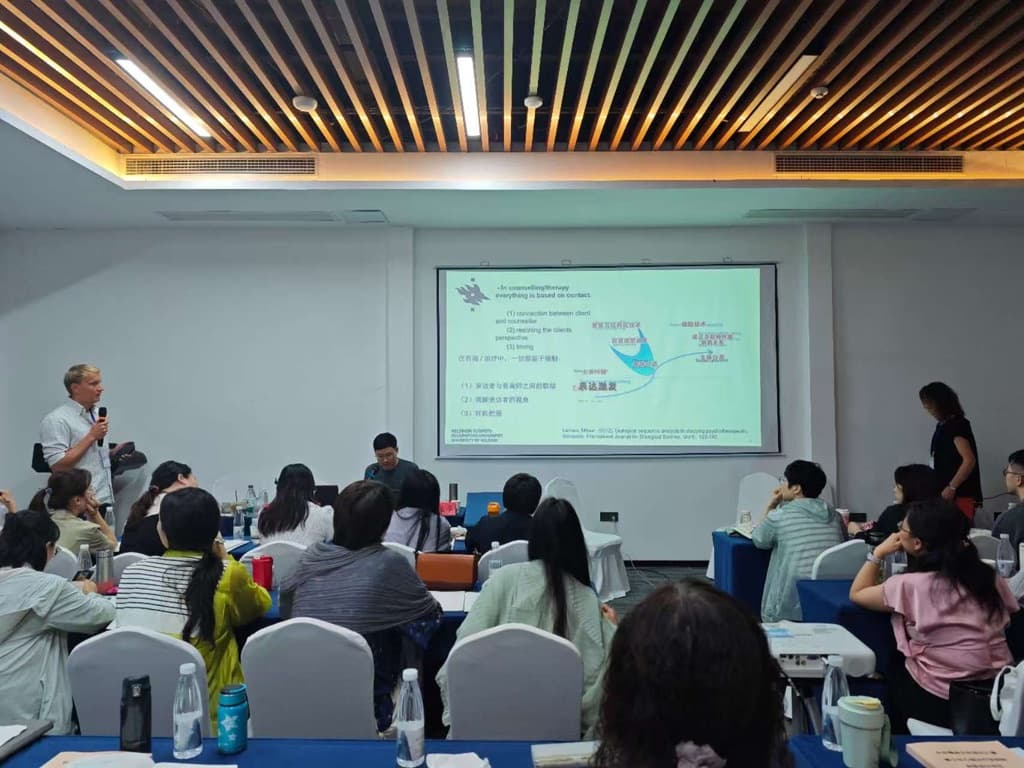
My research method is Dialogical Sequence Analysis — a clinical way of listening that tracks how a person positions themselves in speech in relation to what matters to them. A key insight of DSA is that what can be said, and how, is always shaped by whom the expression is addressed to. DSA preserves this connection, which is often lost in research.
Leiman, 1992, 1994, 1997, 2000, 2002, 2004, 2006, 2011, 2012; Tikkanen, 2015; Valkonen, 2018; Kivikkokangas & Leiman, 2018, 2019; Kivikkokangas, Laitila & Leiman, 2019; Kivikkokangas, Leiman, Laitila & Stiles, 2020; Kivikkokangas, Leiman & Enckell, 2026 — www.diasek.com →
DSA-Intelligence
I am developing an AI-powered DSA tool as part of a NIPRT research project. The goal is to make the precision of DSA accessible to a wider community of researchers and clinicians.
NIPRT — Nordic Institute for Psychotherapy Research and Training
Forthcoming talks
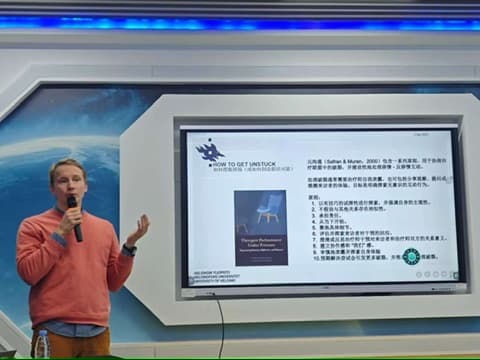
Building Relational Resilience: Practitioner Reflections on Creating Cultures of Care
Society for Psychotherapy Research International Congress, Osaka, Japan
Climate panel (with Friederike Winter, Magdalena Budziszewska, Clare Shepherdson)
Navigating Patient Vulnerability: Micro-Analysis of Analyst Action Under Relational Pressure
Society for Psychotherapy Research International Congress, Osaka, Japan
Panel: Therapist Under Pressure (with Carolina Altimir, Friederike Winter, Angela Ferreira)
How to do single-case research in the age of AI?
Society for Psychotherapy Research, European Chapter Meeting, Bristol
Panel: AI in Psychotherapy — Research, Practice, and Patients (with Arianna Teti and Charlie Duncan)
Mapping Climate Distress: A CAT-Based Workshop Using the Climate and Ecological Emergency Booklet
International Cognitive Analytic Therapy Association Conference, Athens
Workshop with the CAT Climate Special Interest Group
Finding and creating your own style as therapist
China–Finland CAT Programme, China
Open lecture — Inquire to attend →
Visiting researcher and teacher
Ritsumeikan University, Osaka, Japan
Publications
Peer-reviewed articles
Hilden, H-M. & Kivikkokangas, S. (forthcoming). Imagery rescripting as part of cognitive analytic training therapy.
Reformulation
Books and chapters
Kivikkokangas, S., Sheard, T., Sowerby, M. & Samuels, J. (forthcoming). Living with the climate and ecological emergency: A cognitive analytic therapy approach to psychological sustainability.
Cambridge Handbook of Psychology and the Planet. Cambridge University Press.
Kivikkokangas, S., Luhtavaara, A. & Nissinen, T. (forthcoming). Identities, animalities and the climate emergency.
Cambridge Handbook of Psychology and the Planet. Cambridge University Press.
Kivikkokangas, S. (2014). Nuoren psykoterapia.
2014In P. Nurmi (Ed.), The adolescent and anger. PS-Kustannus: Helsinki.
Other publications
Kivikkokangas, S. (2020). Mitä unet ovat?
2020Psykoterapia, 39(2), 3–6.
Kivikkokangas, S. & Manninen, P. (2017). Miltä psykoterapian tulevaisuus näyttää 25 vuoden päästä?
2017Psykoterapia, 36(3), 227–236.